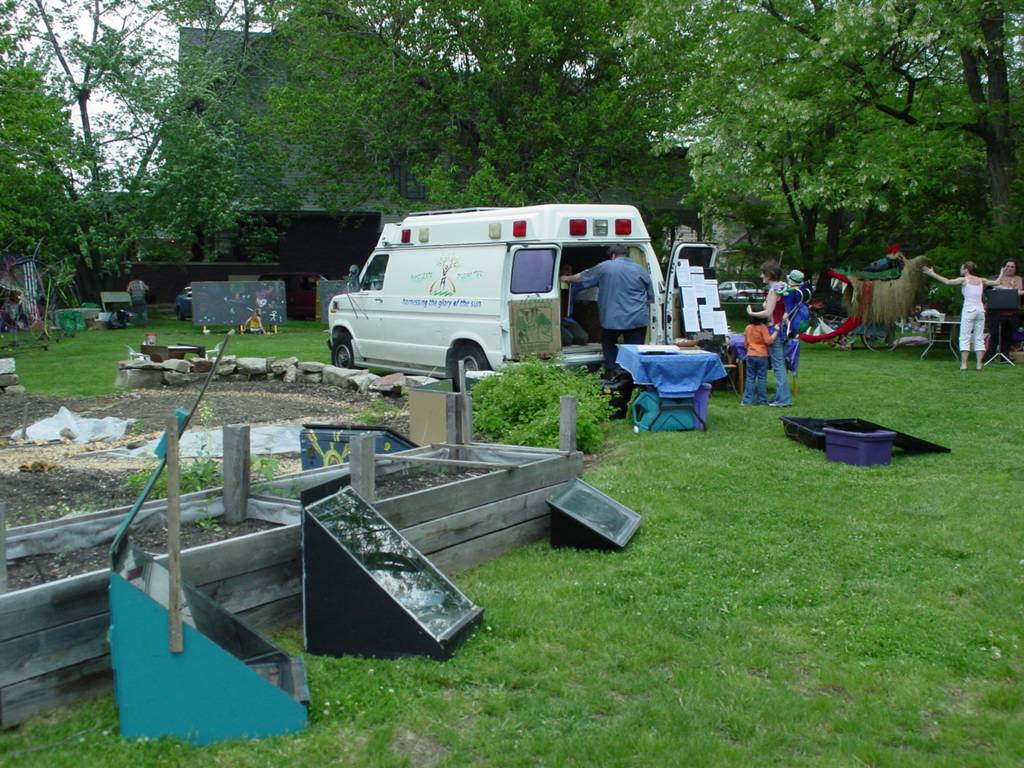
5.27.2004

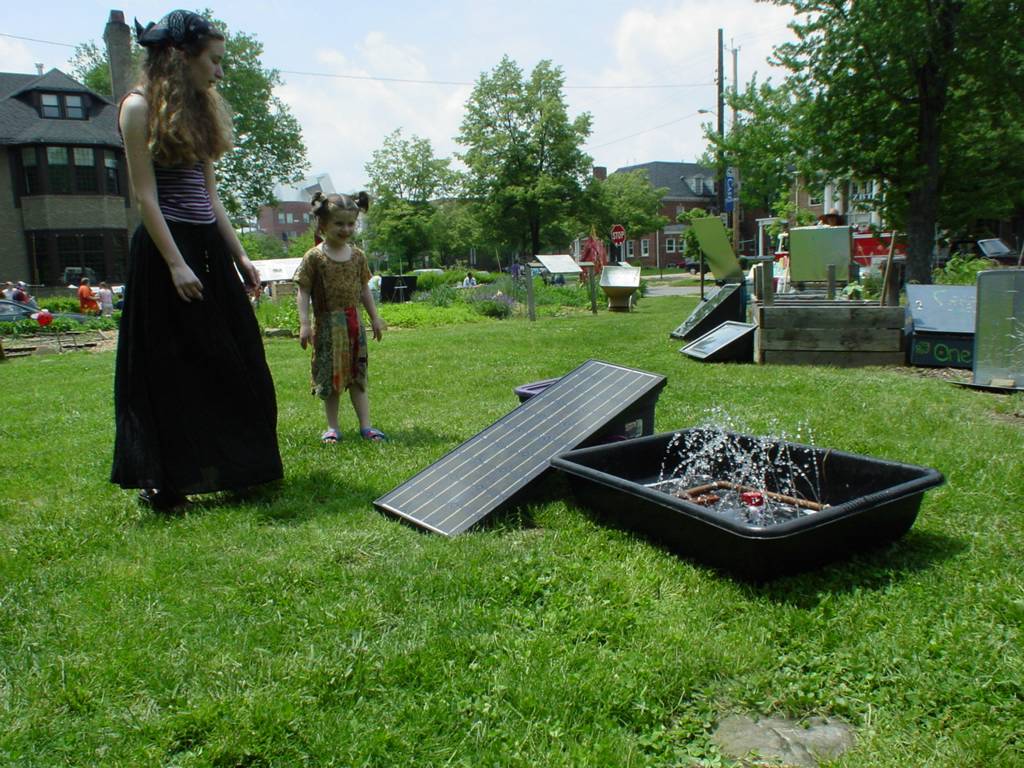
The Ambulance's Solar Interactive Water Feature  Posted by Hello
The Earthwise Traveler Ambulance Live at the Hessler Street Festival Posted by Hello

5.21.2004

Truth In Labeling

by: Dean Kleckner, Chairman, Truth About Trade & Technology

When a new Swedish beer hit the European market earlier this year, activists from the radical group Greenpeace did their best to make sure nobody would drink it. Like a bunch of mobbed-up racketeers, they pursued delivery trucks around Copenhagen and urged storeowners not to stock Kenth beer, as it’s called. “We stayed up all night printing materials to hand out at the stores and arranging chase cars,” one of them confessed in the Wall Street Journal.

Arranging chase cars? So that’s what it’s come to for Greenpeace: High-speed intimidation to prevent consumers a full range of food choices.

The beer in question is no ordinary pilsner - its biotech beer, in which a portion of the barley is replaced by bt corn grown in Germany. It’s also clearly labeled as such. The EU has just adopted a complicated set of rules demanding special labels on food containing even trace amounts of biotech ingredients. Kenth beer became the first product to carry the label--and its maker is hoping the novelty will translate into sales.

It’s in our interest, of course, for biotech food in Europe to seem ordinary rather than extraordinary – which it’s not. With the EU’s new labeling regime just now going into effect, European consumers finally may have a chance to eat genetically enhanced food the way Americans do everyday. Perhaps when they discover that biotech food doesn’t look or taste any different from other kinds of food, they’ll begin to overcome the irrational fears that mischievous groups such as Greenpeace have instilled in them.

That’s the optimistic view. There are good reasons to hold it. Science and time really are on our side--biotech food is perfectly safe and healthy. Perhaps the finicky Europeans just need a little extra time to get used to that idea. Eventually, their biotech labels will be regarded as innocent pieces of information, like the “Nutrition Data” tables we find on our own food in the United States.

The pessimistic view is that people will see the biotech label and think it’s a biohazard sticker--a dire warning to keep away. If Greenpeace deploys enough chase cars, then it might be possible to think that their thugs will win this battle for public opinion for a little longer.

Yet there’s perhaps a more fundamental question to consider: Just how complicated are these new EU regulations? They’re calling for field-to-fork traceability, i.e., demanding that every piece of biotech food have a detailed provenance. There’s nothing wrong with that in theory, because biotech food has nothing to worry about in terms of its safety. In practice, however, this requirement that somebody keep track of virtually ever kernel of corn may prove to be prohibitively expensive.

Just imagine that, following years of protectionist trade policies, we advocates of biotechnology finally pry open the European market only to have it snap shut again. Not because of market forces or sound science but rather, a nonsensical decree invented by prejudiced, “finger in the wind” bureaucrats.

With regulations like these, who needs chase cars? Or protectionism?

We’ll have to give the new EU rules a chance to work and see what happens. Frankly, we don’t have much choice in the matter. These guidelines have been adopted and they currently offer us the best chance we have to make progress among skeptical Europeans. We need to change hearts and minds in London, Paris and Copenhagen.

The very notion of labeling biotech food is profoundly silly. Consider what one European food manufacturer recently said: “Third, fourth, and fifth generation food derived from genetically modified foodstuffs will have to be labeled. A glucose syrup, for example, derived from starch, that in turn hails from a GM maize, will have to be labeled as such.”

Egad – what a labeling mess!

But then again, given Europe’s insistence on labeling, does anybody else have a better idea? If these food labels are the first step toward common-sense and public acceptance, then I’ll live with them.

Our goal is to have Europeans come to the realization that it’s normal and healthy to eat biotech enhanced food. At a certain level, I don’t care if it requires the handholding of special labels, so long as we get there.

And “getting there” is the ultimate test. If these labels give products a fair shake, then Europeans will come to embrace biotech food. They’re sensible people down deep, and they’ll taste the truth--as long as government regulators and chase cars let them.

As Shoppers Grow Finicky, Big Food Has Big Problems

Kraft Buys Back to Nature, Seeks Upscale Offerings; Atkins Diet Takes a Bite; At Giant Eagle: 375 Cheeses

By SARAH ELLISON
Staff Reporter of THE WALL STREET JOURNAL
May 21, 2004; Page A1

Tracey Daugherty grew up on Kraft Macaroni & Cheese, but she won't feed it to her 18-month-old son. That's a huge problem for Kraft Foods Inc.

With $31 billion in sales last year, Kraft says it still helps fill pantries in 99% of U.S. households. But it and the other giants of the processed-food industry have hit a wall in growth, barely managing to stay ahead of gains in the population.

Two big factors: price pressure from stores such as Wal-Mart, now the nation's largest food retailer, and continued competition from grocery-store brands.

That's why Kraft needs consumers such as Ms. Daugherty, who are setting the tastes for the next generation. The 33-year-old Pittsburgh mom, whose lawyer husband is trying to lose weight on the Atkins diet, says she started to worry about sodium and artificial foods when her son was born. These days she opts for fresh produce, chicken, fish and an occasional Amy's Organic frozen dinner when pressed for time.


"Kraft's products definitely have a childhood nostalgia, so it's hard to completely give up on them," she says. "But they're not on my shopping list."

Ms. Daugherty and millions of other consumers are shopping at Whole Foods and other such markets, demanding healthier, tastier, more sophisticated foods -- and they're willing to pay for it. Many are also growing wary of the very feature upon which Big Food built itself: mechanized food production and highly technical innovations to create "better than natural" processed food.

While natural foods and gourmet items still represent a small portion of overall food spending, they boast the best growth rates in the food industry. To capture a portion of that growth, the food behemoths are being forced to upend old business models, find new suppliers and rapidly improve the ingredients and quality of their products.

For Kraft, the nation's largest food company, keeping up with consumers' rapidly changing tastes has been especially tough. Four years ago, Kraft made a big bet on high-fat snacking when it purchased Nabisco, the nation's biggest maker of cookies and crackers. The timing was terrible: The deal was made just as consumers were becoming obsessed about obesity and other food-related health issues. Kraft's more recent efforts to buy its way into the organic world have had mixed results. Kraft's profit for the first quarter fell 34%, following a rise of just 2.4% last year. The company's shares were trading at $29.95 in 4 p.m. New York Stock Exchange composite trading yesterday, down 47% from their peak in June 2002.

Kraft last year held discussions to buy or license the brand name of Organic Valley, a LaFarge, Wis., organic-dairy cooperative where sales grew 25% last year to $156 million. The meetings were friendly, but the farmers that control Organic Valley were "aghast" when Kraft suggested using their organic milk in highly processed products such as Lunchables, said someone who was there.

"They were talking about making organic processed food, and that's not something that jibed with the farmers," said another person familiar with the discussions. No deal transpired, but Organic Valley is now supplying organic milk and dairy products to Kraft.

Both companies declined to comment on the details of the talks. But George Siemon, CEO of Organic Valley, said: "We've been approached by every major food company in the country, and we really believe in organics from the ground up, and we believe in our independence."

Old Playbook

Other big food companies also are struggling to redefine themselves. At first, the industry stuck to its old playbook: adding new features to mainstay brands. These iconic names stayed ahead of generic rivals through brand extensions (Kraft Thick 'N Creamy Macaroni & Cheese, Oreo Double Stuff). Kraft spent a fortune on advertising and commanded a higher price than store brands. The Oreo cream was thicker. The Chips Ahoy! cookie had more chips. But the underlying product was the same.

In the last several years, Campbell Soup Co. has spent hundreds of millions of dollars refitting its factories to improve its soups. Unilever, dragged down by low-growth products like margarine, is revamping its Slim-Fast diet products and other products to fit the new low-carbohydrate craze. Nestle SA, which has spent roughly $20 billion acquiring brands from Ralston Purina pet food to Hot Pockets frozen sandwiches, is looking for growth in the intersection of food and pharmaceuticals -- known in the business as "phood."

Back in 2000, Kraft looked as if it was putting itself on top of the food chain when it agreed to buy Nabisco. A year later, Philip Morris Cos. (now Altria Group Inc.) floated 16% of Kraft on the public market. The IPO, still one of the largest ever, carried big expectations. The company promised double-digit growth rates, and Kraft's portfolio of brands including Oscar Mayer meats, Jell-O gelatin and Ritz crackers was the envy of the food industry.

But last year, higher costs for retiree pensions and rising prices for commodities such as flour, milk and cocoa put a dent in Kraft's earnings. Growing worries about obesity and the mass appeal of the Atkins low-carbohydrate diet also took a toll.

After a series of earnings misses, Kraft late last year demoted its co-CEO, Betsy Holden, widely identified with Kraft's recent stumbles, and elevated her counterpart, Roger Deromedi, to the sole CEO post. Mr. Deromedi, who had run the company's international businesses, quickly moved to cut 6,000 jobs, or 6% of Kraft's work force. He lowered the company's long-term targets for profit growth, saying Kraft needed to invest more money in freshening brands that had fallen out of favor.

"You can't keep selling the same thing forever," Mr. Deromedi said in an interview earlier this year. "Consumers are changing. Unless you change your offering enough to keep it fresh for today, then you are going to have a more significant problem going forward."

Since he took his position, he has bought up tiny companies like Veryfine Products Inc., maker of the fast-growing Fruit20 flavored water, and expanded Kraft's deal with Starbucks Corp. to distribute its Tazo tea in addition to Starbucks coffee in grocery stores.

The company is also working to increase the healthiness of its offerings, such as removing artery-clogging trans-fats from Triscuits and Oreos, and launching smaller, 100-calorie "snack-packs" of some products.

Still, with the lion's share of the company's sales in products like traditional Oreos and Maxwell House coffee, Mr. Deromedi also defended Kraft's existing lineup: "It's not like we need to completely transform ourselves because what we're making today isn't being eaten," he said. "You have to offer a range of products to a range of consumers."

Kraft executives say they have been steadily pushing into the gourmet market. Company executives estimate that about $2 billion in sales now come from brands like Gevalia mail-order coffee, Boca soy burgers, Athenos cheese, Balance bars, Altoids mints, DiGiornio Pizza and its licensing deals with Starbucks and others.

While its talks with Organic Valley were stalling, Kraft concluded negotiations to acquire the tiny Back to Nature brand, which generated less than $10 million in sales in 2002. Kraft estimates that the natural and organic category of food is about $15 billion and grows at a rate of about 9% to 10% a year.

In January, Kraft said it would expand Back to Nature into 19 new products and 15 reformulated granolas and cereals. Next month it plans to start selling those products, which include macaroni and cheese with organic cheese sauce, sesame ginger rice thins and organic cheeses.

Seeking the 'Seekers'

Kevin Scott, a Kraft general manager in charge of Back to Nature, says he's not out to get the "loyalists," who eat only organic and who make up less than 2% of households in America. Instead, he says he is targeting "natural or organic seekers," the 15% to 20% of households that buy a natural or organic product three to four times a year.

Mr. Scott says Kraft has established strict "ingredient principles" for Back to Nature, which includes using no artificial preservatives, colors or flavors; no genetically-modified corn or soy ingredients; no hydrogenated or partially-hydrogenated oils, and to use natural sweeteners like cane juice and fruit sweeteners. The Back to Nature brand uses organic ingredients whenever it can, says Mr. Scott. "Sometimes we can't source an organic ingredient in the quantity we need, or we can't find an ingredient that meets our flavor profile," he says. Back to Nature cheese and its cheese sauces are all stamped with the USDA Organic seal, which means the products contain at least 95% organic material.

At a Pittsburgh Giant Eagle grocery store, shopper Rebekah Beil, 27, shows just how much things have changed. The store's gourmet-cheese counter holds 375 varieties and the tapas cart holds 20 kinds of olives. The Kraft cheeses are aisles away in the dairy section next to the butter.

Eyeing the olives in the tapas cart, Ms. Beil said she sticks to the "perimeter" of the store, avoiding prepackaged products in the center. A real-estate broker, she cooks for her boyfriend most nights and shops on the weekends on the "strip," a collection of wholesale markets with Italian products, fresh fish and the like. She left the store with an assortment of deli meats, olives and cheese.

Organic and gourmet products, areas dominated by dozens of smaller players, are enjoying much faster growth than the giant food companies. The market for gourmet beverages and sweets has grown 48.4% to $14.7 billion since 1998, according to a study by market-research firm Packaged Facts. Specialty condiments and cheese sales have grown 26.3% to $5.5 billion in that period.

Some grocers have latched on to the trend. Last fall, grocery chain Albertson's, which long had relied on its low-end private-label entries, introduced a high-end line of frozen products called Essensia, which include tiramisu and ravioli striped with sun-dried tomato and flavored with basil pesto. "Our goal is to design food that can be served to the most discriminating dinner guests," says Terry Lee, vice-president of corporate brands for the grocery chains.

To understand the challenge Kraft faces, consider cheese, its single biggest product. In 1916, J.L. Kraft's patent for processed cheese helped catapult Kraft from a commodity business to a unique cheese company with a product that came off assembly lines with more consistent quality than natural cheese and stayed on shelves longer without spoiling.

The company's next cheese breakthrough was Velveeta in the late 1920s. Then in the 1940s, Kraft scientists started working on a way to produce cheese in slices. Using a "chill roll" machine that caused hot cheese quickly to cool as it revolved over a cold drum, a sheet of cheese could be uniformly sliced into three-inch squares and stacked. Within one year of its national introduction in 1950, Kraft Deluxe processed slices became the most successful product introduction in the company's then nearly 50-year history. Cheez Whiz hit store shelves soon after.

The company has honed its skills, chopping and processing cheese into snackable forms, over several decades, as consumers demanded more convenience. Starting in the early 1990s, "shredding cheese drove the business for many, many years," says Mr. Deromedi, who once headed the unit and still avows an "incredibly strong" passion for the cheese business. "We've had great success just slicing our chunks of cheese, or adding reclosable packaging."

While he says those kinds of changes "seem very mundane," they can boost sales with a relatively small investment. Kraft's bagged cheese cubes come in five varieties. Even Cheez Whiz is being marketed as a dip: It now comes in a wide-mouthed jar with a picture of a tortilla chip on the label. In March, Kraft introduced a new DiGiornio blend of shredded cheese with parmesan, romano and Asiago.

Lately, Kraft's cheese business has been pressured by an onslaught of high-end products. Last year, U.S. sales of natural Asiago cheese, primarily distributed by a handful of importers and private-label brands, jumped 43% to $7.4 million, according to Information Resources Inc. Sales of Kraft aerosol cheese, which includes Cheez Whiz, fell 9.6%. Kraft's natural cheese sales grew 5.3%, while sales of its processed cheese fell 2%.

Paul Peterson, vice president of sales at Lactalis SA, a $5.5 billion French dairy company that is the largest purveyor of Brie cheese in the U.S., estimates that U.S. sales have risen about 10% a year for the past three years, with last year's growth slightly higher.

These cheeses often require different skills than those of Big Food. Unlike the automated production lines at Kraft's plants, which churn out more than two billion pounds of cheese a year, the Lactalis U.S. plant in Wisconsin has its workers turn individual Brie circles by hand every day during the eight- to 10-day curing process. Some are ready earlier than others, and only trained workers watching the white layer of mold on each Brie circle can evaluate when it's ready.

As Kraft tries to move upscale with its Athenos and Back to Nature cheese lines, it is also still playing the repackaging game. It's latest effort: new labels touting cheeses as low in carbohydrates. "The products have always been low in carbs," says Mr. Deromedi. "It's not like we've had to create a whole new something to get at that."

4.28.2004

Cleveland's Rapid Transit Authority explores more sustainable transportation.

EUCLID CORRIDOR: Purchased 21 vehicles at a cost not to exceed $900,000 each, from New Flyer of America Inc. The low-floor articulated coaches will have state-of-the-art hybrid-electric propulsion and design, and be used on the Euclid Corridor Transportation Project. The concept is known as BRT, or Bus Rapid Transit. The vehicles will have two doors on the driver's side, and three doors on the other side. They will be cleaner, quieter and offer much lower emissions. The vehicles offer 46 seats, 120 standing capacity, with places for two wheelchairs and two interior bike racks. The total award of $20.52 million includes money for research and development, operator and maintenance training, parts and maintenance. About $1.97 million of that will be spent on design, engineering and testing, and federal funds will pay for 80 percent. Because an existing vehicle will be re-designed to meet Cleveland's needs, no precise artwork is yet available. Board Vice President Beverly Burtzlaff hailed the purchase as "a huge historic moment," and said she is especially pleased that the vehicles will be environmentally friendly.

4.27.2004

Chillin' Advice for tense greenies who need to mellow out


by Umbra Fisk

27 Apr 2004

Questions relating to the environment?
Ask Umbra.

Dear Umbra,

I'm the poster child for a late-twentysomething environmentally responsible adult. I use less than 100 gallons of gas a year, less than a 100 kilowatt-hours of electricity a month, less than 20 gallons of water per day, less than 100 therms of natural gas during the winter in Minnesota. I take my garbage out once every two months because nearly everything is recycled, composted, or bought in reusable containers. My house, built in 1921, scores a 9.8 out of 10 on the Energy Star assessment (I document it on my website). All my investments are socially responsible. My job is working with renewable energy. I buy all-organic food from my local food co-op and/or community supported agriculture farm. You can see I'm working hard here to improve my life environmentally (although compared to the rest of the world, I wonder if I'm actually any better than the average).

But sometimes it's not enough and it tears me apart. Some days I'm fine, others I'm not. I've spent a month debating whether to switch from my socially responsible phone company to the local behemoth to save $36 a year and really increase my call-time flexibility. I'm getting bitter that no one else seems to care -- drive, drive, drive.

What's a green to do? Support group? Green girlfriend? Cleansing ceremony by Ralph Nader?

Mike
St. Paul, Minn.

Dearest Mike,

You've got to chill out. The way you're headed, you'll get a rare stress-related illness and then spend months wondering if you should go to the doctor and use up all those disposable gauze pads. Take some deep breaths and calm down. There is help for people like you.

I would spend time complimenting you on your admirable success in reducing your personal environmental footprint, but I'll wager that no amount of kudos will satisfy your obsessive nature. Our best hope is to find a way to relax you, and a way to relieve the terror of failure that crowds your brain.


Relax -- go to it.

May I gently suggest taking up some type of calming activity? Millions of tightly wound people find peace and relaxation through spiritual or meditative practices such as Hatha yoga, Buddhism, Quaker meetings, deep breathing, tai chi, and Catholic confession. Others shun the obviously emotional and turn instead to physical cleansing through exercise. Or there's always relaxation through over-the-counter medication. Whatever sounds good to you: Just try something, preferably lickety-split. You're adding to the stress pollution level of your community.

Once you're feeling a bit more relaxed, make goals for yourself. You're approaching the giant problem of environmental destruction with no clear idea of how to measure success, so of course you are sometimes torn apart. Sit down and write out the highest hopes you have for your personal environmental impact on everything from your home to your neighborhood to the earth. Look carefully at those hopes and from them select the realistic goals for what you might be able to achieve in your lifetime. Set reasonable, human timelines for achieving these goals. You've obviously done quite a bit on your house. What could you feasibly advance on your street, or in your town? By laying out the parameters of your ideals and being honest with yourself about what you can accomplish, you'll get a better grip on success and failure. Be sure to recognize your successes and feel happy when they happen.

Lastly, yes, go find a support group. Any support group will do. Start a book club, join the local Sierra Club chapter, take kids to pick up trash on the roadside, anything. There are groups designed to help the sensitive, earth-conscious person grapple with the despairs of modern living, like the Sacred Earth Network, as well as New Age folks who help people find their purpose, like Joanna Macy. You need comrades, so go out and get you some. And good luck with that ulcer.

Soothingly,
Umbra

thank you umbra for another eye opening and home hitting disertation. Thank you GRIST.

4.02.2004

Blue Vinyl Location and Directions

The film will be shown on April 8th at 7pm
at Case Western Reserve Universities Strosacker Auditorium
Directions Can be Found Here.
questions please email inquiry@buckeyesustainability.org

3.17.2004

BLUE VINYL

A Toxic Comedy

With humor, chutzpah and a piece of vinyl siding in hand, Daniel Gold & Judith Helfand's award-winning Blue Vinyl sets out in search of the truth about vinyl, America’s most popular plastic. Helfand's parents’ decision to “re-side” their house with this seemingly benign cure-all turns into a toxic odyssey that most ordinary homeowners would never dare to take. A detective story, an eco-activism doc and a rollicking comedy all rolled into one --- it’s a journey you can’t afford to miss.

**“Best Documentary” & “Best Research” Nominee, 2003 Emmy Awards**
**Documentary Excellence in Cinematography Award, Sundance Film Festival (2002)**
**2002 Environmental Messenger of the Year, Environmental Grantmakers Association**

"That rare muckraking film with a sense of humor." Kenneth Turan, Los Angeles Times

“Yes… The Green Building Movement may have just acquired its first cult film." Environmental Building News

“Scary and hilarious!” Elvis Mitchell, New York Times

Buckeye Sustainability Institute has arranged a screening of the film in Cleveland, Ohio on the evening of April 8th, 2004 at Case Western Reserve University. It's timing has never been more relevent.

3.16.2004

Vinyl Toys and Medical Devices Declared Safe *Provinyl Propaganda Alert!!*

- A blue ribbon panel headed by former Surgeon General C. Everett Koop has declared that vinyl toys and medical products made with phthalate plasticizers are not harmful to children or adults. In fact, the panel found the use of plasticizers in some medical devices makes them safer than alternative materials. The panel, convened by the American Council on Science and Health (ACSH), based its findings on a comprehensive review of all available scientific literature - including pending studies - on two additives, DINP and DEHP, used in toys and medical products to provide flexibility. While reassuring consumers that they can be confident that vinyl toys and medical devices are safe, Dr. Koop criticized consumer and environmental activists for waging a battle over the safety of well-tested chemicals. In a strongly worded column in The Wall Street Journal, Dr. Koop urged them instead to focus their attention on the "demons that lead us along the road to sickness and death," such as smoking, excessive drinking, drug use, accidents in the home, unprotected sex, poor nutrition and lack of exercise. "The enemy is not tiny amounts of chemicals that have proved safe over many years," he said. A summary of the report is available on the Vinyl Institute's Web site, www.vinyltoys.com.
EnVIronmental Briefs, August 1999

Weight of Science Continues to Support Vinyl Toys *provinyl propaganda alert*

- As Environmental Briefs was going to press, scientists were continuing to review available data on the potential health effects of phthalate plasticizers in soft vinyl toys. However, both the U.S. Consumer Product Safety Commission (CPSC) and a European scientific group recently supported the continued safe use of phthalates in these toys. The CPSC report released in December refused some calls for a ban or recall on phthalate-containing toys, citing the lack of evidence of any imminent risk to children. "Few, if any, children are at risk from (phthalates) because the children don't ingest enough of the chemical to rise to a harmful level," said CPSC Commissioner Ann Brown. "In fact, it doesn't even come close." More information on this developing issue can be obtained at www.vinyltoys.com.
EnVIronmental Briefs, December 1998

3.15.2004

Indoor Agents, Not Plasticizers, Linked to Asthma

- A new study by the Institute of Medicine (IOM) of the National Academies of Science discredits earlier claims that linked plasticizers in products like vinyl flooring and wallcovering to childhood asthma. Researchers found instead that cockroaches, cat dander and dust mites definitely make asthma worse, while other agents such as secondhand tobacco smoke aggravate symptoms in small children. They also found that exposure to dogs, mold and fungi and cold viruses exacerbate symptoms. Researchers placed plasticizers in the study's lowest category, saying they could find "inadequate or insufficient evidence" of a link. An earlier study had suggested a relationship between vinyl flooring and wallcovering and bronchial obstruction in children, but was criticized for not measuring exposure to other agents that are proven allergens, including those listed in this study. On the other hand, the research emphasizes that intensive cleaning may help alleviate asthma symptoms, suggesting a clear benefit to the use of vinyl flooring and wallcovering because they can be easily cleaned and do not trap dust and pet hair.
EnVIronmental Briefs, May 2000

3.05.2004

Ohio EPA Police Blotter - Div. of Haz Waste reached a settlement with Kautex Inc.

Ohio EPA reached a settlement with Kautex Inc. for violations of
hazardous waste regulations and issued an administrative consent order
on March 3, 2004. The violations occurred at the company's facility
located at 474 South Nelson Avenue, Wilmington, Ohio. The settlement
includes a $77,550 civil penalty, of which $55,000 will be deposited
into the state's hazardous waste clean-up fund. In lieu of payment the
remaining $22,550 of the civil penalty settlement, Kautex will implement
a supplemental environmental project (SEP). You can view the consent
order on-line here

Thank you Eric Hendrickson. The above consent order link sends you to the
official notice of violation the company received. It reads as a good list of
things one ought not to do.

3.04.2004

What Is My Definition of Sustainability?

I was asked the question recently and quite honestly I choked. Not because I don't know what it is or how to define it, but because I like bits and pieces of so many different definitions and I attempted to reconstruct my definition on the spot. So to answer the question more formerly rather than in the middle of a heated discourse, I present to
you all -> the components of my idea of sustainability.

At first I liked the following:

Sustainability (as defined by first by the World Commission on Environment and Development in 1987 and just recently adopted by the City of Seatle) -

"meeting the needs of today without compromising the ability of future generations to meet their own needs."

This definition seems to confirm the foundational idea of limitations imposed by the state of technology upon the environments ability to meet both present and future needs.

But as many people have pointed out, we choose the wrong word to build a
movement about. Or did we? Well maybe. Its debatable but here's the thing...
Take into account the movements current momentum, and I feel that
if all we want is sustainability were not aiming high enough.

The best way I can depict this is to relay an old analogy I have heard
over and over again over the years (so its impossible to give
credit where credit is due). It goes like this:

What about a marriage or long term relationship.... if all you want for
that is to be 'sustainable', many feel something is wrong with your
outlook (and your significant other will probably agree [I polled my
wife to confirm this and she agreed]) !!

So based on that analogy, we need a new word. Now people say "Beyond
Sustainability" a lot, and call 2 conferences in 2 years that also. But if 98% of the
universe cant even spell the word, should we build upon the term or deconstruct, put it aside
and aim towards a better term?

more later.... . . . . .

The G8 in Evian, France.

What's happening in Geneva - the "City of Peace?"

Thank you's go out to CM at BSI for the great photo essay linkages.

2.24.2004

Extra! Extra! Newsprint is compostable.

Dear Umbra,

Two questions: Does the colored ink in newspapers still contain
chemicals bad for a compost pile? Also, what about the colored ink
printed on cardboard boxes? I want to have a safe compost pile to use in
a garden.

Anonymous


Dearest Mysterious Reader,

Some readers may find gardening questions in February a bit jarring. By
choosing to answer this one, I'm taunting those of you who don't live in
the Pacific Northwest. True, we may be moistly imprisoned under an
unrelenting steely sky, daylight may be a dim memory, and mildew may be
our constant companion, but at least we can consider composting in
February. Ahh, compost. So helpful in relieving seasonal affective
disorder.

Extra! Extra! Newsprint is compostable.
Pigments combine with a "vehicle" and a "binder" to create specific
inks for various printing projects. The pigment and the vehicle are the
bad boys. Paper composting and mulching is haunted by the specter of the
heavy metals used as pigment in commercial inks in the past. For years,
the vehicle was petroleum-based, but the industry is slowly switching
over to soy- or vegetable-based inks. However, inks labeled "soy-based"
are still permitted (and likely) to contain some amount of petroleum.

Pigments themselves still contain heavy metals such as zinc and copper,
although overall amounts of heavy metals have been reduced. Although
toxins are present in quite small amounts, all the sources I consulted
agreed that contemporary printed newsprint, including colored newsprint,
and cardboard boxes are safe for garden use. Glossy inserts, shiny ink
of any sort, magazines, and colored paper do not make appropriate
compost or mulch materials, due to a higher prevalence of toxics within
the paper and ink, and likelihood of "de-inking" (ink sliding off the
paper into your garden).

One further thing: If you're gardening in an urban or suburban area,
ink is a drop in the contamination bucket. It's far more likely that
your soil will be contaminated by other sources, such as lead paint,
pavement runoff, or car exhaust that washes from building walls into the
soil. Get your soil tested for heavy metals before food gardening and
avoid food gardening within 10 feet of a building. What is toxic is
often invisible to the eye.

Bariumly,
Umbra

We at Greenspieler really like Umbra. Thank you Umbra once again for imparting us with your wisdom!

Umbra Answers All About Fabric Softener

Dear Umbra,

With winter upon us, I'm thinking about a serious matter: fabric
softener. During the summer, I don't use any. However, with snow
looming, static cling is on my mind. Long story short, which is better:
liquid fabric softener or dryer sheets?

Allie
Shippensburg, Penn.


Dearest Allie,

Your home will be a happier, healthier place if no fabric softener
darkens your dryer. Both liquid and sheet contain a stunning amount of
notoriously toxic chemicals, which often serve to make the softener
smell pretty. Turns out fragrances are usually composed of a witch's
brew of solvents -- which explains why some folks come over all funny in
the presence of artificial scents.

Quite a few of the fabric-softener solvents, particularly if exposed to
heat, are hazardous when inhaled or when they come into contact with
skin. A less-toxic solution is to add a cup of white vinegar during the
final rinse cycle in your washing machine. I also suspect that if you
don't overdry your clothing -- that is, if you pull it out of the dryer
when it's still slightly damp to the touch -- you'll get less static.
And I'd recommend switching to all-natural fabrics such as cotton.

Warmly,
Umbra

2.20.2004

Farmer's take heart from Prince's stand on GM crops

Farmer's take heart from Prince's stand on GM crops

Steve Dube, The Western Mail

WELSH FARMERS last night lent their support to Prince Charles's call for a GM-free Britain.

Organic farmer Tom Latter welcomed the Prince's contribution and said it was doubly important because he had been voted Farming Personality of the Year by Farmers Weekly magazine last year.

Full Text Here!!

A short course in proposal writing.


Haga click aquí para el curso en Español


Introduction
The subject of this short course is proposal writing. But the proposal does not stand alone. It must be part of a process of planning and of research on, outreach to, and cultivation of potential foundation and corporate donors.

This process is grounded in the conviction that a partnership should develop between the nonprofit and the donor. When you spend a great deal of your time seeking money, it is hard to remember that it can also be difficult to give money away. In fact, the dollars contributed by a foundation or corporation have no value until they are attached to solid programs in the nonprofit sector.

This truly is an ideal partnership. The nonprofits have the ideas and the capacity to solve problems, but no dollars with which to implement them. The foundations and corporations have the financial resources but not the other resources needed to create programs. Bring the two together effectively, and the result is a dynamic collaboration.

You need to follow a step-by-step process in the search for private dollars. It takes time and persistence to succeed. After you have written a proposal, it could take as long as a year to obtain the funds needed to carry it out. And even a perfectly written proposal submitted to the right prospect might be rejected for any number of reasons.

People Power: Capturing The Body's Energy For Work On and Off Earth

People Power: Capturing The Body's Energy For Work On and Off Earth

By Erik Baard
Special to SPACE.com
posted: 07:00 am ET
28 November 2001

Covert military operations and space shuttle missions are both burdened by the fact that they rely on an inefficient, energy-wasting machine: the human body. Considering one of the biggest logistical problems planners face is getting power to equipment in remote places like Afghanistan or the moon, researchers are devoting their efforts to cut some of those losses through "energy harvesting" from the human body.

If that gives you creepy images of people wired up as batteries a la "The Matrix," stop fretting. What NASA and the Pentagon want to do is scoop up electrons from what bodies in normal activity produce: heat, motion, flexing and stretching, compression, urine, and body heat. This is quite different from other human-powered schemes that take extra exertion, like spring or dynamo flashlights and radios that are wound-up by a special handle, flashlights that are squeezed by the user to generate charge, or flywheels that store energy from a cord that is pulled.

A simple version of a piezoelectric, energy-harvesting device, these sneakers broadcast a location signal while the wearer walks.

According to the Center for Space Power and Advanced Electronics, a NASA commercial center in Alabama, the human body is on average 15% fat, capable of producing 11,000 watt hours. When the average Joe eats his daily bread, he takes in 3,300 watt hours. The charge rate is about 7kW if the waiter starts pushing you out the door after a half hour lunch, according to the Center. "Clearly the amount of energy consumed by an individual is sufficient to provide power for electronic devices if a suitable method can be found to convert a small fraction of that energy to electricity," the Center concludes in a report on the subject.

Broken into usable terms, waiting to be harvested are 81 watts from a sleeping person, 128 from a soldier standing at ease, 163 from a walking person, 407 from a briskly walking person, 1,048 from a long-distance runner, and 1,630 from a sprinter, according to the center. But of course there’s not 100% capture. Body heat, for example, can only be converted with 3% efficiency with current thermoelectric materials.

Advances in nanotechnology and materials science are causing energy needs to drop at the same time production and transfer of it is increasing. The military applications are humble still, though, aimed at small gear like personal battery chargers, medical sensors, displays, gun sights, and range finders. Boots that turn the compression of a compound into voltage have already powered a radio, according to the Defense Advanced Research Projects Agency. NASA is hoping to feed a range of body monitors, electronics and mission-specific devices. In the commercial sphere, companies are racing to power simple things like watches for now, with an eye to scaling up to handheld PDAs in the future.

Some of the most promising mechanisms for passively converting human body functions into electricity are:

Piezoelectric devices: Piezoelectric substances, like some ceramics, also generate electrical energy from mechanical strain but without the need for voltage to be applied. This well-understood material is the core of "heel strike" devices that generate electricity from walking. "Generating 1-2 watts per shoe is not out of the question. A major issue that remains is the durability of these devices," Dr. Robert J. Nowak, program manager for energy harvesting at Darpa, wrote to SPACE.com. Great for soldiers, bad for astronauts: "giant steps are what you take, walking on the moon."

Urine-based fuel cell: Yes, you can turn pee into power and not just by turning a turbine after a few beers. First subject urea to enzymatic hydrolysis to make carbon dioxide and ammonia, and then oxidize the ammonia to nitrogen and water. But the center notes that "one problem with the system is the need for alkaline conditions that may require transport of sodium hydroxide, a hazardous compound. Also, to achieve power generation in the range of 0.5 - 1W, a system to concentrate the breakdown products of urea, such as reverse osmosis, will be necessary." But for astronauts and soldiers on the run, "one attractive feature of this fuel cell concept is the production of water as a by-product of the system."

Inertial energy scavenging: You can own a piece of this technology already – some Seiko watches are powered by a weight that swings as you move, driving a tiny generator. No one expects to generate much electricity from these systems, but deployed in each element needing electricity they could do the trick in concert. Also, while gravity is absent in space, inertia is not.

People Power: Capturing The Body's Energy For Work On and Off Earth (cont.)

Electromagnetic generator: Large muscular groups (especially legs) can generate electricity by simple motions against gravity and small direct current permanent magnet motors. But the center cautions, "there is little or no efforts within the scientific community to design efficient small generators of the type needed for harvesting of human energy."

Thermoelectric materials: These materials convert body heat into electricity by using combinations of materials (metals or today, new ceramics) that are poor thermal conductors and good electrical conductors. When two of them at different temperatures come into contact, electrons migrate, charging a battery or creating usable current through something called the Seebeck Effect. The trouble is that you need great temperature differences to get significant energy, and "on Earth most places are pretty close to body temperature," notes Dr. Henry Brandhurst, director of the center. And what about in the cold depths of space? For the inner solar system at least, photovoltaic panels seem like a better bet, he says.


A simple version of a piezoelectric, energy-harvesting device, these sneakers broadcast a location signal while the wearer walks. Image courtesy the IEEE. Click to enlarge.

But that skepticism hasn’t slowed down efforts at NASA to improve the technology, and one company is already pushing it as an off-the-shelf product. Applied Digital Solutions is unveiling "Thermo Life." The company is "working closely with a watch manufacturer," says Keith Bolton, the chief technology officer. Already the technology has proven itself capable of keeping analog watches ticking, he reports.

And Dr. Rama Venkatasubramanian of the Research Triangle Institute reported in Nature this month a breakthrough in new materials that could double or triple the output of thermoelectric generators.

Electrostrictive polymers: These materials create charge when stretched after voltage is induced through them. No prototype has been made, and there are concerns about how quickly this material might wear out. But it does dovetail nicely with NASA’s conception of the spacesuit of the future, which will be skin tight to maintain mechanical pressure on blood systems in place of the ambient Earth air pressure replicated in "puffy" suits today.

Electrostatic force arrays: (Also called Integrated Force Arrays) A cousin of electrostrictive polymers, this is a new technology. It’s expensive and untested in power generating applications, or for simple durability.


Thank you w3.space.com , click here for full text @ site

1.30.2004

Ohio lakefront at risk due to pending legislation. Enjoy shore access? Better listen up and read about House Bill 218. Thanks toEcocitycleveland.org for the story.
KeySpan To Maintain Aquarium Fuel Cell.Business Wires
BROOKLYN, N.Y.--(BUSINESS WIRE)-

KeySpan (NYSE: KSE) has been selected to maintain and service the PC25C(TM) fuel cell power plant installed by the New York Power Authority at the New York Aquarium, in Coney Island, Brooklyn.

The PC25(TM) is a 200-kilowatt natural-gas-powered fuel cell manufactured by UTC Fuel Cells, a unit of United Technologies Corp. (NYSE: UTX). Two such PC25s provide electric power for the NASDAQ sign's home, the Durst Organization flagship at Four Times Square, also known as the Conde Nast building. The building is a 48-story office tower, located on Broadway between 42nd Street and 43rd Street, in Manhattan.

"Fuel cells are extremely reliable, efficient, and clean, and will play an increasingly large role in meeting America's energy needs," said Robert B. Catell, Chairman and CEO of KeySpan Corporation. "KeySpan is particularly well-positioned to take advantage of this growing market. KeySpan has compiled an impressive track record in maintaining and servicing PC25 fuel cells in the New York metropolitan area, and enjoys a terrific relationship with UTC, the principal manufacturer of commercial fuel cells in North America."

Full Text: Right Here, Right Now.

Sustainable retail markets: Forestry companies must prove their wood is harvested to certain environ

Sustainable retail markets: Forestry companies must prove their wood is
harvested to certain environmental standards

The Gazette, 24 January 2004 -

Home Depot claims to be the world's largest home-improvement retailer.
So it's not surprising that environmental groups targeted the company,
demanding to know if wood in Home Depot's aisles came from responsibly
managed forests. "We were accused at some points of being the largest
destroyer of the world's forests," said Ron Jarvis, vice-president for
lumber merchandising for Atlanta-based Home Depot. The retailer had a
moment of reckoning in the late-1990s, when it realized it didn't know
where its wood was coming from, he said.

Two years after that, Home Depot adopted a purchasing policy aimed at
buying wood from sustainable forests.
With $58.2 billion U.S. in total sales in fiscal 2002, Home Depot
carries a lot of clout.
For forest companies worldwide, the pressure is on to provide proof
their wood is harvested to certain environmental standards.
Certification of those standards through outside audits is becoming an
inescapable cost of doing business in global markets. It is also
becoming an integral part of overall corporate image management.

Bruce McIntyre heads the sustainable solutions practice for Canada of
consulting and auditing firm PriceWaterhouseCoopers.
Aside from advising forestry companies on strategic issues, PWC
performs certification audits, although it doesn't do both for the same
companies.

"The real benefit (of certification) is market access, for example, as
a preferred supplier," McIntyre said. "More and more customers have
purchasing policies."

For publicly owned forestry companies though, making the expensive
investment in certification is a balancing act.
"Shareholder returns are important, so the question for management is
to balance the costs vs. the benefits," McIntyre said.
The choice of standard is equally loaded. Companies must pick a
standard that suits their operations from a technical point of view. But
since they are competing for the public's "environmental vote," as
McIntyre puts it, they must also pick a standard that is recognized and
effectively marketed.
There are several global forestry certification standards, but three
predominate in North America.
The CSA standard was developed by the Canadian Standards Association.
Its defining feature is public involvement in land-use questions. The
vast majority of harvesting in Canada takes place on public land. The
American Forest & Paper Association developed the SFI standard. Some
observers say it is most appropriate in the U.S., where most working
forests are privately owned.

The FSC standard was instituted by the Forest Stewardship Council, a
diverse global group made up of environmentalists, the timber trade,
labour groups, professional foresters and indigenous peoples. The FSC
standard puts a lot of emphasis on environmental and social issues.
There is overlap between the standards - most deal with biodiversity,
forest regeneration, soil and water quality and protection of wildlife.
In January 2002, the Forest Products Association of Canada announced
that its members, 30 of the country's largest producers of pulp, paper
and wood products, would have to adhere to one of the three standards by
the end of 2006. FPAC estimates that its members control about 75 per
cent of the managed forests in Canada.

Jean-Pierre Martel, vice-president for sustainability for FPAC, said
the cost of certification will be about $100 million over five years for
FPAC members. The cost of the initial and continuing audits account for
the smaller portion of the price tag, McIntyre said.

The bigger chunk consists of items like staff time and changing
marketing programs.
Martel agrees certification is being driven by environmental groups and
customers, from construction companies to retailers.

"About 80 per cent of production in Canada is exported, so
certification is a question of access to markets," said Martel.

FPAC plays up its member-companies' move to embrace certification, but
some countries, in particular Sweden, already certify most of their
forest practices, according to the World Wildlife Fund. Steven Price,
director of forests and trade for the Canadian branch of the World
Wildlife Fund, applauds FPAC's commitment to certification. FSC is not
the most widely used of the three standards in Canada in terms of area
(CSA ranks first, SFI second), but it is the fastest growing, according
to Price. And, for the WWF, the gold standard of certification is FSC.
The organization prefers FSC because a broad range of stakeholders sets
its standards, it has performance goals vs. merely process goals and it
emphasizes protecting forests, Price said.

While forestry companies have not been able to count on price premiums
for certified products, contrary to what had been predicted, Price sees
wide-ranging benefits to certification. Market share and avoiding
boycotts are just two. Other benefits include employee motivation. "Your
employees don't want to be seen as bad guys ruining the forest," Price
said.

With the rigorous FSC standard gaining ground and industry consulting
environmentalists, Price sees a turning point in the making. "The
forestry industry has a chance to take a huge step forward if they meet
these standards," he said

Thank you Lexis Nexus and WBCSD

Environment: Action Plan to Reconcile Green and Industrial Concerns

Environment: Action Plan to Reconcile Green and Industrial Concerns

European Report, 28 January 2004 - Boosting economic growth without
playing havoc with the environment is not a lost cause: one strategy is
to develop and promote greener technologies. This is the thrust of a
European Commission proposal to launch an Environmental Technologies
Action Plan (ETAP).

Due to be officially unveiled in a Commission Communication issued on
January 28, the 10-point plan is divided into three major categories.
The planned measures range from market research, to creating suitable
market conditions and acting on a global scale. The action plan is
expected to require a budget of some Euro 23.676 million over the
2004-2008 period: 1.58 million for DG Environment-related schemes and
22.096 million for those emanating from DG Research. It is scheduled to
be presented to the March 25/26 EU Summit in Brussels, as part of the
debate on meeting the Lisbon Strategy targets and the application of the
European Sustainable Development Strategy agreed on during the
Gothenburg Summit in Sweden in June 2001.

Environmental technologies include all technologies whose use is less
environmentally harmful than relevant alternatives. They encompass
technologies and processes to manage pollution (e.g. air pollution
control, waste management), less polluting and less resource-intensive
products and services and ways to manage resources more efficiently
(e.g. water supply, energy-saving technologies). Thus defined, they
pervade all economic activities and sectors, where they often cut costs
and improve competitiveness by reducing energy and resource consumption,
and so generate fewer emissions and less waste. This Environmental
Technologies Action Plan (ETAP) therefore aims to harness their full
potential to reduce pressures on our natural resources, improve the
quality of life of European citizens and stimulate economic growth. It
is based on the recognition that encouraging the choice of advanced
environmental technologies in all investment and purchasing decisions
will go some way towards realising this potential, thus widening their
market and reducing their cost.

EU's global responsibility.

The EU also shares responsibility for the global environment because,
just as the resources it uses are not limited to those from Europe, nor
are its negative environmental impacts. The European Commission stresses
how Europe has shown leadership in international policies for
sustainable development, such as the Kyoto Protocol and the ten-year
framework of programmes for sustainable production and consumption
established at the Johannesburg World Summit on Sustainable Development.
Well targeted, Europe's potential for innovation can help develop
technologies that other countries may need to develop their economies,
while reducing environmental degradation. Other countries are also
developing these technologies, says the Commission and maintaining EU
leadership will require increased effort but will, in turn, consolidate
its strong position to argue for serious efforts by other countries to
provide a continued drive for sustainable development.

thank you world buisness council for sustainable development (WBCSD) -
full story @
http://www.wbcsd.org/plugins/DocSearch/details.asp?type=DocDet&DocId=3802

1.22.2004

THE BIG APPLE OF OUR EYE
World Trade Center Reconstruction Will Set New Eco-Friendly Standard

Reconstruction of New York City's World Trade Center area -- site of
the 2001 terrorist attacks -- is set to make a green splash as one of
the largest eco-friendly building projects ever undertaken. Under
environmental guidelines expected to be released today for public
comment, new structures on the massive site (which will contain as
much commercial space as the city of Indianapolis) would have, among
other features, roofs that catch rainwater for use in toilets and in
efficient cooling systems. The guidelines would also encourage
builders to use renewable and recycled materials, recycle
construction wastes, and use cleaner fuels in construction equipment
and trucks. "We're talking about building an environmentally
sensitive city. That's never been done before," said Daniel Tishman,
chair of a construction company doing work at the site. Enviros in
the city plan to push for even higher standards than those laid out
in the guidelines.

straight to the source: The New York Times, Anthony DePalma, 20 Jan 2004
BUBBLICIOUS

Scientists Consider Funky Plans to Avert Climate Change

Plans to slow global warming once dismissed as, well, loopy need to
be taken seriously, concluded scientists at a conference on climate
change in Cambridge, U.K. The proposed schemes can be divided into
two families -- they aim either to capture greenhouse gases such as
carbon dioxide to prevent their buildup in the atmosphere, or to
shield the planet from solar radiation. The first category includes
plans to sprinkle the oceans with iron to absorb CO2 or bury
compressed CO2 underground. The second category -- which found more
favor with scientists -- includes more fanciful proposals such as
using thousands of bubble-making machines to create bigger, more
reflective clouds or (we kid you not) sending billions of tiny silver
balloons into the atmosphere to reflect the sun's light. When an
alien civilization reconstructs the events that led to humanity's
demise, we here at Grist hope that our balloon-bedecked planet
convinces them that, however short-sighted, we had a good sense of
humor.

straight to the source: The Boston Globe, Fred Pearce, 20 Jan 2004